The business-process harness.

A new category for governed human-AI collaboration. Humans, AI, and hybrid actors executing against a single primitive — with one audit trail for all of them.

Models are rented. The harness is owned.

A category, not a feature.

Most AI products embed operational intelligence inside prompts, runtimes, or orchestration code. All three are ephemeral. Models deprecate. Prompts drift. Orchestration logic lives only inside the particular agent framework that wrote it.

Inistate makes a different commitment. We externalize workflows, states, forms, transitions, and audit trails into persistent schemas. Those schemas become the operational source of truth . Humans, AI, and hybrid actors all execute against them, through one primitive, with one audit shape.

We call this substrate the harness. It is the category Inistate defined and the category we lead.

What makes something a harness.

  1. 01

    A schema-as-contract

    The schema is what the AI reads to know what is possible. The schema is what the AI writes to record what happened.

  2. 02

    A unified action primitive

    Every operation against the harness is a

    State → Activity(Form) → State
    transition. Whether the actor is a human in a browser, an AI agent through MCP, or a hybrid sequence of both, the primitive is identical.

  3. 03

    A single audit substrate

    Every transition produces one history event with identical fields: by, on, changes, and an optional ai object. The audit shape does not vary by actor type. Compliance reporting is a query, not a reconstruction.

  4. 04

    A discovery protocol

    Workspaces, modules, schemas, transitions, and tools are all discoverable through the MCP server. The AI does not need pre-loaded context to operate inside an unfamiliar deployment. It bootstraps through the protocol.

  5. 05

    A confidence and intention recording layer

    AI-submitted transitions persist confidence scores. Below threshold, the system records an intention event with flagged: true and the AI must escalate to a human. Regulation-grade human-in-the-loop, built in.

  6. 06

    A multi-actor governance model

    Activities are typed by who can perform them: human-only, AI-only, hybrid, or any-actor. Promoting a human activity to AI changes one field in the configuration. The process model, the form schema, and the audit are unchanged.

Each of these is shipped. Each is documented in the MCP Server Specification v1.0. Each is exercised in the seven proofs.

The properties depend on each other.

The six properties are not a checklist. They are a dependency graph. Each layer requires the ones beneath it. Pull any layer and the layers above it collapse.

The dependency graph: twelve layers from form-as-primitive at the foundation up to the consumer promise. Each layer requires the ones beneath it.
"Describe it. Use it." / "Snap it. Track it." Run-by-text on a governed state machine MCP-native operation (19 tools against the unified primitive) No-Prompt AI (the consumer category) Schema-learning + schema-designing Model portability (workflow is the truth, model is swappable) Regulation-ready audit (EU AI Act, FINRA, HIPAA, Colorado AI Act) Confidence gating + intention events Actor Parity (the principle) Single audit schema (one record shape for human/AI/hybrid) Single transition mechanism (State → Activity(Form) → State) Form-as-primitive

A competitor who wants to reach parity cannot copy one feature at a time. The features depend on each other. To reach parity, a competitor must rebuild the substrate in the correct order — an architectural commitment that breaks installed customers and consumes years of engineering capacity.

What the harness is not.

Vendors with adjacent products will tell you they ship a harness. They do not. Each of the four labels below describes a product the harness includes properties of, but none describe what the harness is.

Not

A workflow tool.

Why not

Workflow tools have one actor type: humans through forms, or services through APIs. The harness has unified actor parity from the primitive up.

Not

An agent framework.

Why not

Agent frameworks embed operational intelligence inside prompts and runtimes. The harness externalizes it into persistent schemas that survive the agent.

Not

A low-code app builder.

Why not

Low-code app builders generate UI on top of stateful databases. The harness is a state machine with native AI execution and audit, with UI as one possible surface.

Not

A model orchestration layer.

Why not

Model orchestration layers route prompts between models. The harness is model-portable; the workflow is the truth, and the model is swappable.

See it executing.

Seven demonstrations record the harness executing across orthogonal stress dimensions. Each holds different variables constant and varies others. Together they triangulate the architecture: it is not just correct in any one dimension, it is invariant across all of them.

01
Demo 1 of 7

Multi-Model Relay

User input

"go to LV 00003 and Approve it"

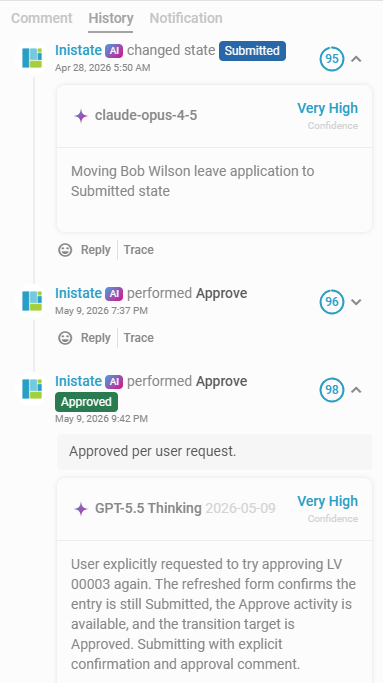
Audit history pane showing transitions performed by Claude Opus 4.5 and GPT-5.5 Thinking on the same Leave Application entry

The leave application LV 00003 was created by a human. Claude Opus 4.5 advanced it to Submitted. GPT-5.5 Thinking approved it. Each transition produced an identical history event.

Architectural property

Actor Parity across model families.

What it proves

Models are interchangeable; the audit is not.

06
Demo 6 of 7

End-to-End Composition

User input

"build a leave application module"

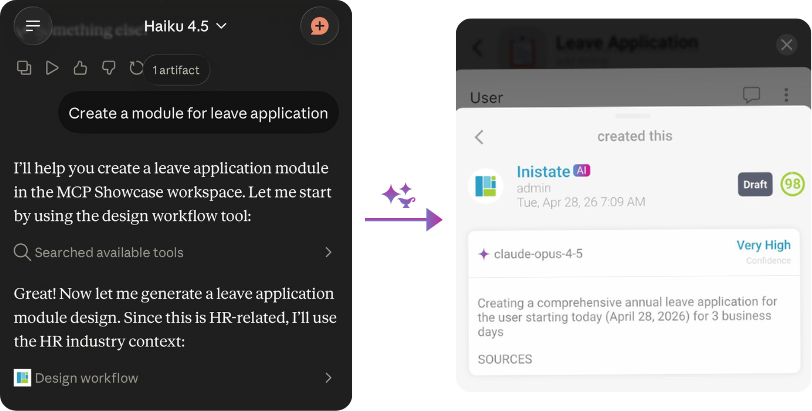
End-to-end leave application lifecycle confirmed in a single session

In a single session, on Claude Haiku 4.5, the AI designed the schema, generated the form, configured the transitions, set up the audit, and ran a test entry through the full happy path.

Architectural property

All architectural properties composing simultaneously, on a small model.

What it proves

Model size is not the bottleneck. Architecture is.

07
Demo 7 of 7

Multimodal Bootstrapping (BP Tracker from a Photograph)

User input

"track this"

Screenshot in production
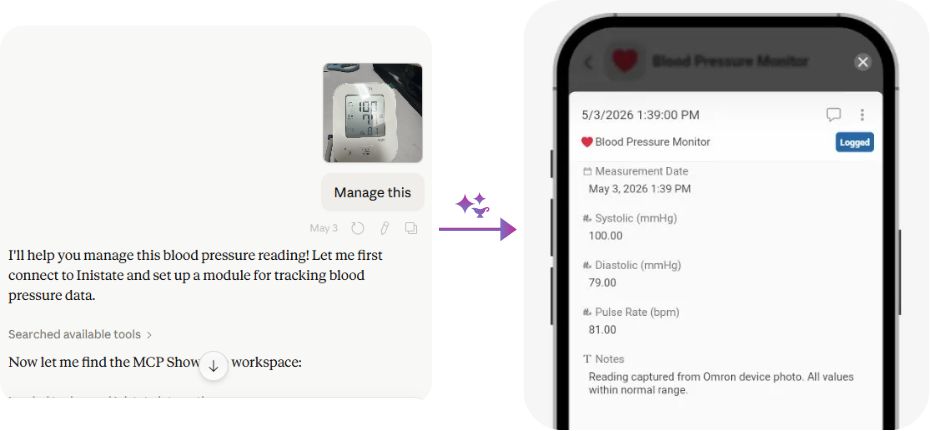
Demo 7 — Multimodal Bootstrapping (BP Tracker from a Photograph)

A photograph of a blood pressure cuff. The AI parsed the image, inferred the schema, generated the module, and made the entry — without a text description.

Architectural property

The harness operates on artifacts, not just on language.

What it proves

Schema-as-the-prompt generalizes beyond text.

Backed by patent.

The harness substrate is covered by US Patent 20230266946 A1 (issued August 2023). The Actor Parity governance extensions are covered by US Provisional Application #64/045,012 (filed April 21, 2026). A competitor must engineer around both layers to ship a competitive harness. The difficulty multiplies; it does not add.