Three clocks govern enterprise AI.
Two of them churn. One of them compounds.

The model you buy today will be deprecated in six months. The harness you buy today will run your operations for the next decade.

Models are rented. The harness is owned.

Three clocks.

The model clock

Tempo: 4–8 months.

Frontier model capabilities double on a six-month axis. Each new generation reframes what is possible. Each new generation deprecates the prompts, the fine-tunes, and the integration patterns of the previous generation. A "best model" decision made today is wrong by Q3.

The regulation clock

Tempo: 18–36 months.

EU AI Act high-risk requirements take effect August 2026. The Colorado AI Act takes effect June 2026. FINRA AI audit requirements expand quarterly. HIPAA enforcement on AI-mediated decisions is sharpening. New regimes ship every 18 to 36 months. Audit posture you cannot evidence is liability you cannot defend.

The harness clock

Tempo: 5–10 years.

Workflows are operational assets. The leave application, the expense approval, the trade settlement, the claims adjudication — these are processes the organization runs every day, year over year. They outlast every model and every regulation. The harness is the layer where they live.

The procurement implication.

If the model clock churns every six months and the harness clock compounds for a decade, the right unit of purchase is not the model. It is the harness.

Most enterprise AI procurement today is doing this backward. Buyers are choosing vendors by which model they ship. The vendor that bundled GPT-4 last year now has to migrate to GPT-5. The vendor that bundled Claude Opus 4.5 will have to migrate to whatever Anthropic ships in November. The vendor that bundled an in-house model will quietly fall behind on capability and cost.

The buyers who chose the harness layer instead are unaffected. Their schemas are durable. Their audit shape is durable. Their workflow intelligence is durable. The model their harness is currently running is a configuration field, not a procurement commitment.

Stop buying by model. Stop buying by use case. Start buying by audit format and harness portability.

Stop buying by model. Stop buying by use case. Start buying by audit format and harness portability.

The economic implication is also significant.

The harness compensates for model capability. A smaller model with the harness produces enterprise-grade output. A larger model without a harness produces a chat transcript.

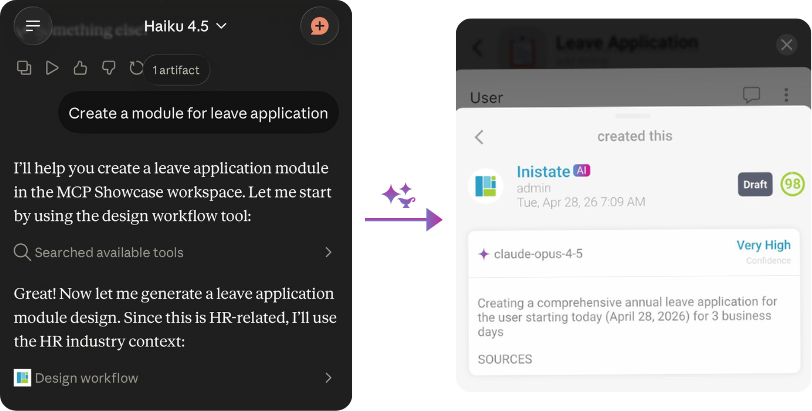
Demo 6 ran on Claude Haiku 4.5 — Anthropic's smaller, faster, cheaper model — and produced a complete, working, audited HR module in five minutes. Demo 7 ran on the same family of small models and bootstrapped a personal health tracker from a photograph and two words.

A 5x to 10x reduction in inference cost per workflow is realistic at scale. As model commoditization continues, that gap widens further. The buyer who built on the harness captures the cost reduction. The buyer who built on the largest available model pays for capability the harness made unnecessary.

06
Demo 6 of 7

End-to-End Composition (Leave Module from One Sentence)

User input

"build a leave application module"

End-to-end leave application lifecycle confirmed in a single session on a small model

In a single session, on Claude Haiku 4.5 (a small, fast, cheap model), the AI designed the schema, generated the form, configured the transitions, set up the audit, ran a test entry through the full happy path, and confirmed the module was production-ready. Five minutes from sentence to working module.

Architectural property

All architectural properties composing simultaneously, on a small model, at small-model cost.

What it proves

Model size is not the bottleneck. Architecture is. A small model with a harness produces enterprise-grade output. A large model without a harness produces a chat transcript.

What to put in your RFP.

A short checklist. Use these clauses verbatim, or adapt them for your procurement system. The clauses are designed to be vendor-neutral; any genuine harness vendor can answer them. Vendors that cannot answer them are not selling you a harness.

  1. 01

    The vendor MUST externalize workflow logic into a persistent, versioned schema that is independent of the model.

  2. 02

    The vendor MUST produce a single audit event shape across human, AI, and hybrid actors, with explicit fields for actor identity, timestamp, changes, and (for AI) reasoning, sources, model, model version, and confidence.

  3. 03

    The vendor MUST support replacement of the underlying language model without modifying workflow logic, schema, or audit format.

  4. 04

    The vendor MUST support confidence-gated execution with intention recording when confidence is below threshold.

  5. 05

    The vendor MUST expose all operational primitives (workflows, schemas, transitions, activities) through a documented protocol (MCP or equivalent) that supports independent integration.

  6. 06

    The vendor MUST provide audit fields that map directly to applicable regulations (EU AI Act Article 14, HIPAA audit controls, FINRA Rule 3110, etc.) without post-hoc reconstruction.